
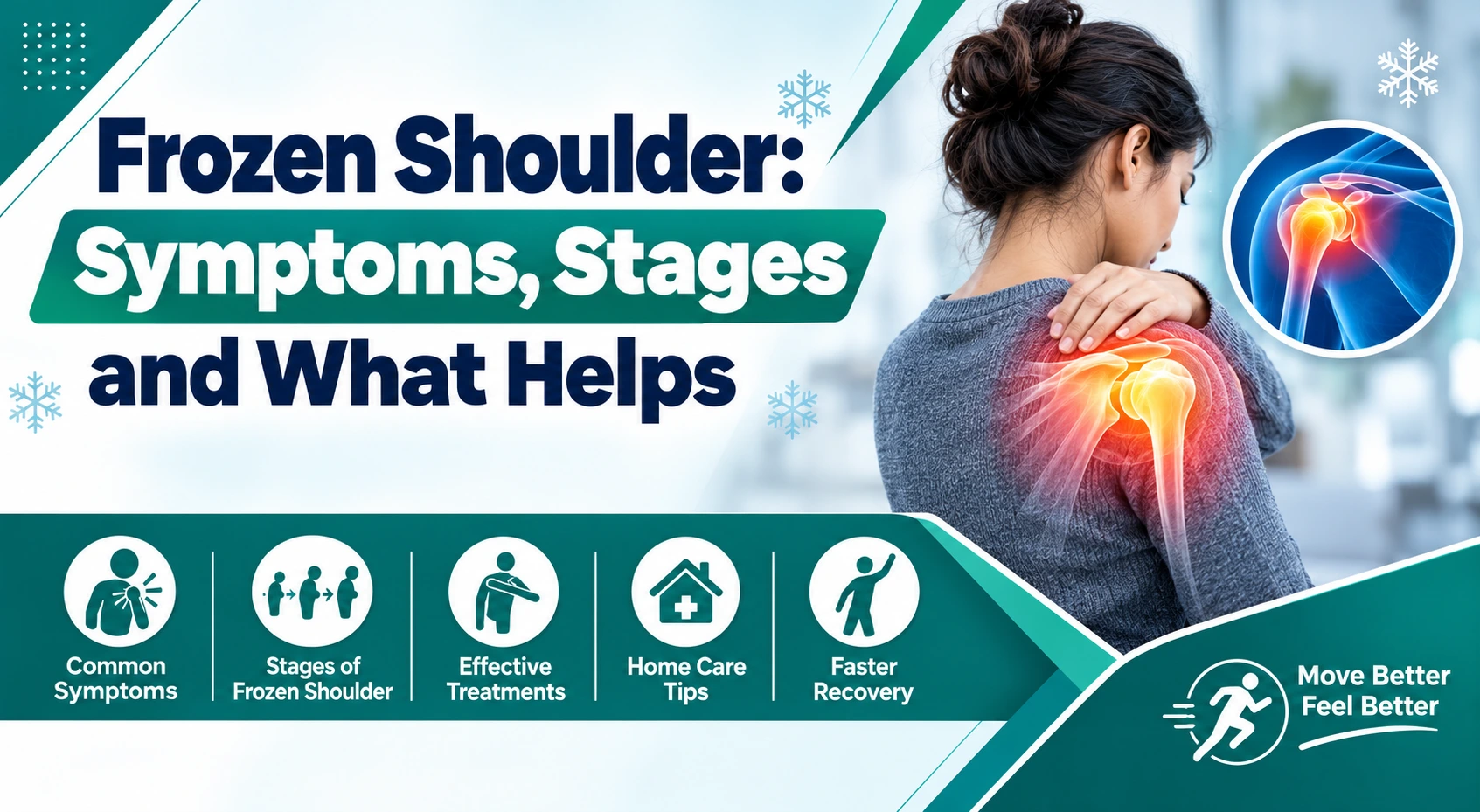
Frozen Shoulder: Symptoms, Stages and What Helps
By Dr. Anuj Jain, M.B.B.S., M.S. (Orth), D.N.B., MNAMS Published and last updated: 21 October 2026.
Frozen shoulder is a common cause of shoulder pain that slowly turns into a stiff, hard-to-move joint. Combing hair, putting on a shirt or reaching into a back pocket becomes difficult. Because it develops gradually and can last many months, it is often mistaken for ordinary shoulder stiffness or a pulled muscle. This article explains how it develops, who is at risk, how it is treated and which shoulder exercises are commonly used.
What is frozen shoulder?
The shoulder joint is wrapped in a thin capsule of tissue. In this condition the capsule becomes inflamed, thickens and tightens, which limits movement. The medical name is adhesive capsulitis. Unlike many other causes of shoulder pain, the joint feels stiff even when someone else tries to move your arm.
The three stages
It usually passes through three overlapping stages:
- Freezing stage. Pain is the main problem and shoulder stiffness slowly increases. The pain is often worse at night. This stage can last a few months.
- Frozen stage. Pain may ease, but shoulder stiffness is at its worst and everyday movements are limited.
- Thawing stage. Movement gradually returns.
The whole course often takes one to three years, though many people improve sooner. Recovery varies from person to person.
Who is more likely to develop it?
- People between about 40 and 60 years of age, and women more often than men
- People with diabetes or thyroid disorders
- Those whose arm has been kept still for a long time after an injury, fracture or surgery
- People with some other conditions, such as heart disease or Parkinson's disease, which have been linked to it in some studies
Diabetes deserves special mention. People with diabetes are more likely to develop a frozen shoulder, and it may take longer to settle, so steady blood sugar control matters. Read more on how diabetes and obesity affect joint health.
Symptoms and diagnosis
- A dull, aching pain in the shoulder, often worse at night and when lying on that side
- Difficulty lifting the arm overhead, reaching behind the back or turning the arm outward
- Trouble with daily tasks such as dressing, combing hair or reaching a shelf
Doctors usually diagnose it by examining the shoulder and checking how far it moves, both on its own and when helped. An X-ray is often advised to rule out arthritis or other bone problems, and an ultrasound or MRI may be used if a tear is suspected. Other causes, such as rotator cuff problems and impingement, can look similar, so a proper assessment is worthwhile if shoulder pain lasts for several weeks.
Treatment options
Treatment depends on the stage and on how much the joint is affected. Options your doctor may discuss include:
- Pain relief medicines, used as advised by your doctor
- Physiotherapy with gentle stretching to keep the shoulder moving
- Heat before exercise to ease tightness
- A steroid injection into the joint, which may give short-term relief, particularly in the painful early stage
- Procedures such as manipulation under anaesthesia or arthroscopic release, only in selected people whose shoulder has not improved after months of non-surgical care
Most people improve without an operation, and surgery is considered only when other measures have not worked. You can read general information on shoulder surgery to understand what it involves.
Gentle shoulder exercises
Shoulder exercises are commonly part of treatment, but they should first be learned from a physiotherapist or doctor, because forcing a painful movement can make things worse. Commonly used examples include:
- Pendulum swing. Lean forward with support, let the arm hang down and swing it gently in small circles.
- Table slide. Sit beside a table, rest the hand on a towel and slide it forward, bending from the hips.
- Cross-body stretch. Bring the arm across the chest and support it with the other hand.
- Finger walk. Walk the fingers up a wall as far as is comfortable.
A warm shower before shoulder exercises can ease stiffness. Move only within a comfortable range, stop if the pain sharpens, and repeat the movements regularly rather than in long sessions. A structured plan of orthopaedic rehabilitation can guide the progress.
Everyday tips
- Dress the affected arm first and undress it last
- Support the arm with a pillow at night if shoulder pain disturbs sleep
- Keep the arm moving gently through the day rather than holding it still
- Avoid heavy lifting and sudden, forceful movements
When to see a doctor
Please consult a registered orthopaedic specialist if you have:
- Shoulder pain that lasts more than a couple of weeks
- Night pain that keeps you awake
- Difficulty with daily tasks
- Shoulder stiffness that follows an injury or surgery
- Fever with swelling, redness or warmth around the shoulder
Sudden shoulder or arm pain together with chest pain, sweating or breathlessness is an emergency: go to the nearest hospital immediately.
Key takeaways
- Frozen shoulder usually improves with time, but the recovery can take one to three years.
- Diabetes raises the risk, so steady blood sugar control matters.
- Gentle shoulder exercises, learned from a professional, help keep the joint moving.
- Persistent shoulder pain or shoulder stiffness deserves a proper examination.
Disclaimer: This article is for general health education only. It is not a substitute for personal medical advice, diagnosis or treatment. Please consult a registered medical practitioner about your specific condition.

Useful Links
Our Services
Dr. Anuj Jain
 "Being an Orthopaedic Surgeons my aim is restoring mobility and keeping our nation in motion."
Dr. Anuj Jain
M.B.B.S., M.S. (Orth), D.N.B. Gold Medalist

