
What Is Ankylosing Spondylitis? Symptoms, Causes, Risk Factors & Treatment
Written for patients by the team at Dr. Anuj Jain's clinic and medically reviewed by Dr. Anuj Jain, M.B.B.S., M.S. (Orthopaedics), D.N.B. (Gold Medalist), Senior Consultant, Orthopaedics and Joint Replacement. Published and last updated: 1 October 2026.
Many people live with back pain for years, assuming it comes from a bad chair, a gym injury or "just stress." But if your back pain began in your 20s or 30s, feels worst in the morning and actually improves when you move, it may be something different: ankylosing spondylitis (AS).
This guide explains what ankylosing spondylitis is, how to spot it early, what causes it, who is at risk and how it is treated, including when an orthopaedic surgeon needs to be involved.
What Is Ankylosing Spondylitis?
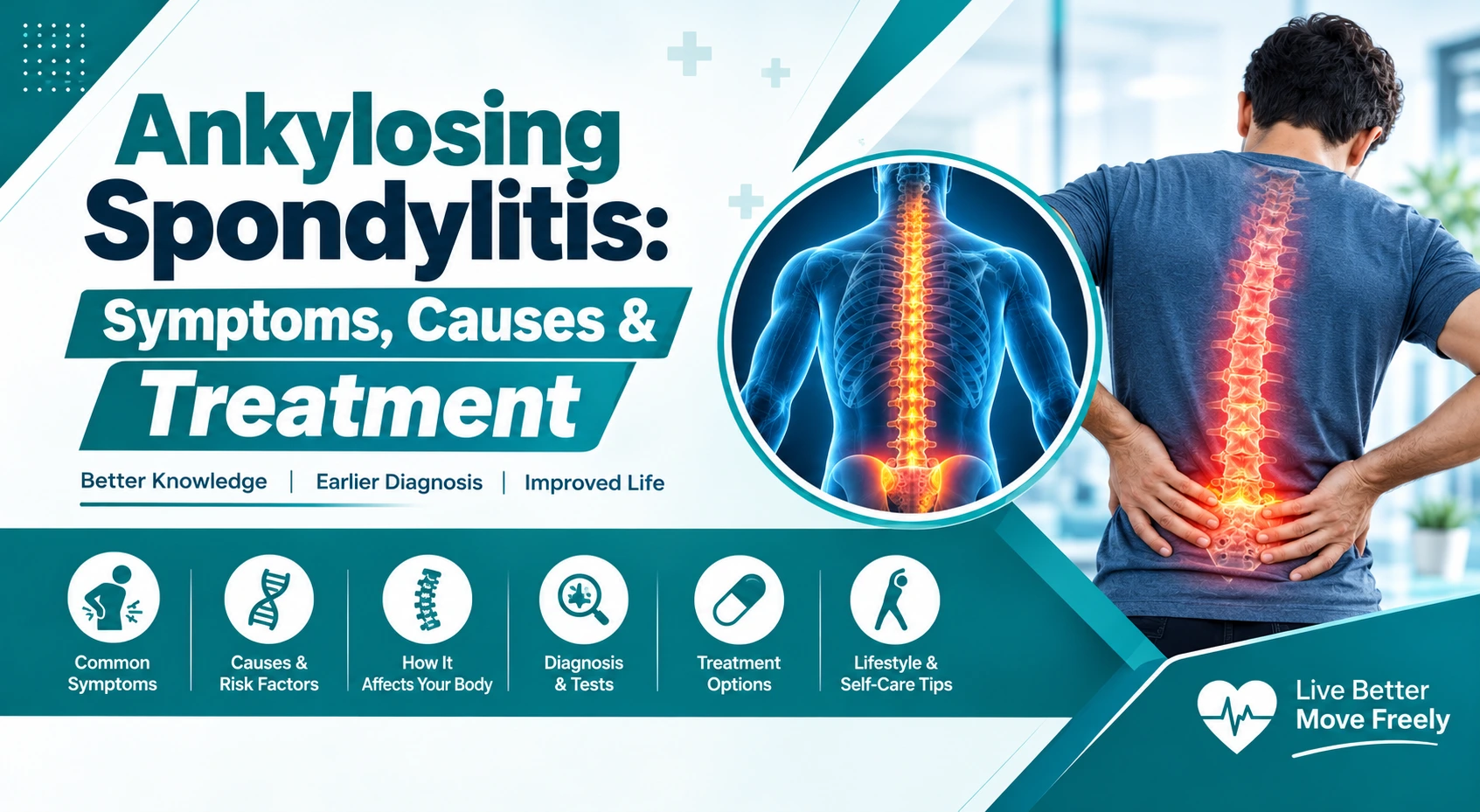
Ankylosing spondylitis is a long-term (chronic) inflammatory arthritis that mainly affects the spine and the sacroiliac joints, the joints where your spine meets your pelvis. It belongs to a group of conditions called axial spondyloarthritis.
The word "ankylosing" means "fusing." In some people, repeated inflammation causes the body to lay down new bone over time. Vertebrae may gradually join together, making the spine stiff and less flexible. In advanced cases this is sometimes described as a "bamboo spine" on X-ray.
Importantly, not everyone with AS ends up with a fused spine. The condition varies a lot from person to person, and modern treatment can slow progression significantly, especially when started early.
Ankylosing Spondylitis vs Normal Back Pain
Most back pain is "mechanical," caused by posture, muscle strain or disc problems. AS back pain is inflammatory, and behaves differently:
| Feature | Mechanical back pain | Inflammatory back pain (AS) |
|---|---|---|
| Typical age of onset | Any age | Usually before 45 |
| Onset | Often sudden, after a strain | Gradual, over weeks to months |
| Morning stiffness | Short | Often lasts 30 minutes or more |
| Effect of rest | Usually improves | Often gets worse |
| Effect of exercise | Often worsens it | Usually improves it |
| Night pain | Less typical | Common, especially in the second half of the night |
Symptoms of Ankylosing Spondylitis
Early symptoms
- Dull pain deep in the lower back or buttocks, sometimes alternating between sides
- Morning stiffness that eases with movement or a warm shower
- Waking at night with back pain and needing to get up and move
- Fatigue and low energy
As the condition progresses
- Stiffness in the mid-back and neck
- Reduced chest expansion or pain when breathing deeply, if the rib joints are involved
- Heel pain or tenderness where tendons attach to bone (called enthesitis)
- Pain and stiffness in the hips, shoulders or knees
- A stooped forward posture in advanced cases
Symptoms outside the joints
- Eye inflammation (uveitis): a red, painful eye with light sensitivity. This needs prompt attention from an eye specialist.
- Links with psoriasis and inflammatory bowel disease in some patients
When to see a doctor
Consult an orthopaedic specialist or rheumatologist if:
- Back pain has lasted more than 3 months, especially if it began before age 45
- You have morning stiffness lasting more than 30 minutes
- Rest makes your back pain worse and activity improves it
- You have a family history of AS or related conditions
- You have repeated heel pain, eye inflammation or hip pain along with back stiffness
Early diagnosis matters. Delays of several years are very common, and that is time during which stiffness can quietly progress. Our guide to joint pain versus arthritis explains other warning signs that should not be ignored.
What Causes Ankylosing Spondylitis?
The exact cause is not fully understood, but AS is considered an autoimmune-related condition, where the immune system triggers inflammation at the places where ligaments and tendons attach to bone.
Genetics play a major role. A gene called HLA-B27 is found in a large majority of people with AS. However:
- Having HLA-B27 does not mean you will develop AS. Many carriers stay healthy.
- Some people with AS test negative for it.
Researchers believe a combination of genes and environmental factors, which are still being studied, leads to the disease. AS is not caused by lifting heavy objects, sitting too long or poor posture, and it is not contagious.
Risk Factors
- Age: symptoms usually begin in late teens to early 40s
- Sex: it is diagnosed more often in men, though women are affected too and may be diagnosed later because their symptoms can be milder or different
- Family history: having a close relative with AS raises your risk
- HLA-B27 gene: a key genetic risk factor
- Other related conditions: such as psoriasis or inflammatory bowel disease
How Is Ankylosing Spondylitis Diagnosed?
There is no single test. Diagnosis combines:
- Clinical history and examination: pattern of pain, stiffness, spinal mobility and chest expansion
- X-ray of the pelvis (sacroiliac joints): can show changes, but these may take years to appear
- MRI: can detect early inflammation before X-rays show damage
- Blood tests: CRP and ESR (markers of inflammation) and HLA-B27
An orthopaedic surgeon often sees these patients first, because back pain, hip pain and stiffness are the main complaints. Treatment is best planned together with a rheumatologist.
Ankylosing Spondylitis Treatment
There is currently no cure, but treatment can control symptoms, protect joints and maintain mobility. Most people lead active lives with proper care.
1. Exercise and physiotherapy (the foundation)
Regular stretching, posture training, back-extension exercises and breathing exercises help keep the spine flexible. Swimming is often recommended because it is gentle on the joints. A physiotherapist can design a routine suited to your stage.
2. Medicines
- NSAIDs (anti-inflammatory painkillers) are usually the first-line treatment for pain and stiffness
- Biologic medicines (such as TNF inhibitors or IL-17 inhibitors) may be prescribed by a rheumatologist when NSAIDs are not enough
- DMARDs may help when peripheral joints (such as knees or ankles) are involved
- Local steroid injections may be used for a specific inflamed joint
Medicines should only be taken under specialist supervision.
3. Lifestyle measures
- Quit smoking, as it is linked with faster progression
- Maintain a healthy weight
- Keep a straight posture while sitting and sleep on a firm mattress
- Stay active and avoid long periods of immobility
4. Surgery: when is it needed?
Most people with AS never need surgery. It becomes an option when joint damage or deformity affects daily life:
- Hip replacement: AS can damage the hip joint, causing severe pain and restricted movement. When medicines and physiotherapy no longer help, a hip replacement can restore mobility and reduce pain. Surgical planning in AS needs particular care because of stiffness around the joint. Read more about hip and knee replacement with Dr. Anuj Jain, including robotic options.
- Knee or shoulder procedures: in selected cases of advanced joint damage
- Spinal correction surgery: rarely, for severe forward-bending deformity or spinal fractures, performed at specialised spine centres
If you already have a hip or knee implant and develop pain, read our guide on revision joint replacement to understand when a repeat procedure may be needed. If you are considering a joint replacement, our article on robotic knee replacement explains how robot-assisted surgery improves precision.
Complications to Be Aware Of
- Spinal stiffness and forward-stooped posture
- Osteoporosis and a higher risk of spinal fractures, even from minor falls
- Hip joint damage
- Recurrent eye inflammation (uveitis)
- Reduced chest movement affecting breathing in advanced cases
Regular follow-up helps catch these early. Because AS raises the risk of weak bones, it is also worth reading about osteoporosis and fracture care on the Dr. Anuj Jain website.
Living Well With Ankylosing Spondylitis
- Do your stretching routine daily, even when you feel well
- Take medicines as prescribed and keep follow-up appointments
- Use an ergonomic workstation and take movement breaks every 30 to 45 minutes
- Consider joining a patient support group, as long-term conditions are easier with support
Frequently Asked Questions
1. Is ankylosing spondylitis curable?
No cure exists yet, but treatment can effectively control inflammation, relieve pain and slow progression.
2. Can ankylosing spondylitis be detected early?
Yes. MRI can show inflammation before damage is visible on X-ray, and a doctor's assessment of your symptom pattern is key.
3. Is ankylosing spondylitis hereditary?
Genes, especially HLA-B27, increase risk, but most children of affected parents do not develop AS.
4. Will I need surgery for ankylosing spondylitis?
Most people do not. Surgery is considered mainly for severe hip damage or significant spinal deformity.
5. Can women get ankylosing spondylitis?
Yes. It is more commonly diagnosed in men, but women are affected too and may be diagnosed later because symptoms can be milder or different.
6. Which doctor should I see for ankylosing spondylitis?
An orthopaedic surgeon or a rheumatologist. Orthopaedic assessment is especially useful when joint pain, hip involvement or deformity is present.
Consult Dr. Anuj Jain
If you have persistent back stiffness, hip pain or joint problems, an early evaluation can make a real difference. Dr. Anuj Jain is a Senior Consultant in Orthopaedics and Joint Replacement with 15+ years of experience, offering consultations at:
- Dr. Anuj Jain Bone & Joint Clinic, Basement, A-12A, Block A, Sector 50, Noida, UP – 201301 (Tue and Thu 6-8 PM, Sat 4-6 PM)
- Sant Parmanand Hospital, Plot No. 1, 2 & 3, Park Area, Yamuna Bazar, Ring Road, Kashmiri Gate, Delhi 110006 (Mon, Tue, Thu, Fri 12-2 PM)
- Kailash Hospital & Neuro Institute, NH-1, Sector 71, Noida 201309 (Mon, Wed, Fri 6-8 PM; Sat 11 AM-1 PM)
To book a visit, call or message the clinic through the appointment options on the official website. Please confirm timings by phone before visiting.
👉 Visit dranujjain.com to book an appointment.
Medical disclaimer: This article is for general education and does not replace personal medical advice. Please consult a qualified doctor for diagnosis and treatment.

Useful Links
Our Services
Dr. Anuj Jain
 "Being an Orthopaedic Surgeons my aim is restoring mobility and keeping our nation in motion."Dr. Anuj JainM.B.B.S., M.S. (Orth), D.N.B. Gold Medalist

