
Squatting After Knee Replacement: Can You Use an Indian Toilet or Sit Cross-Legged?
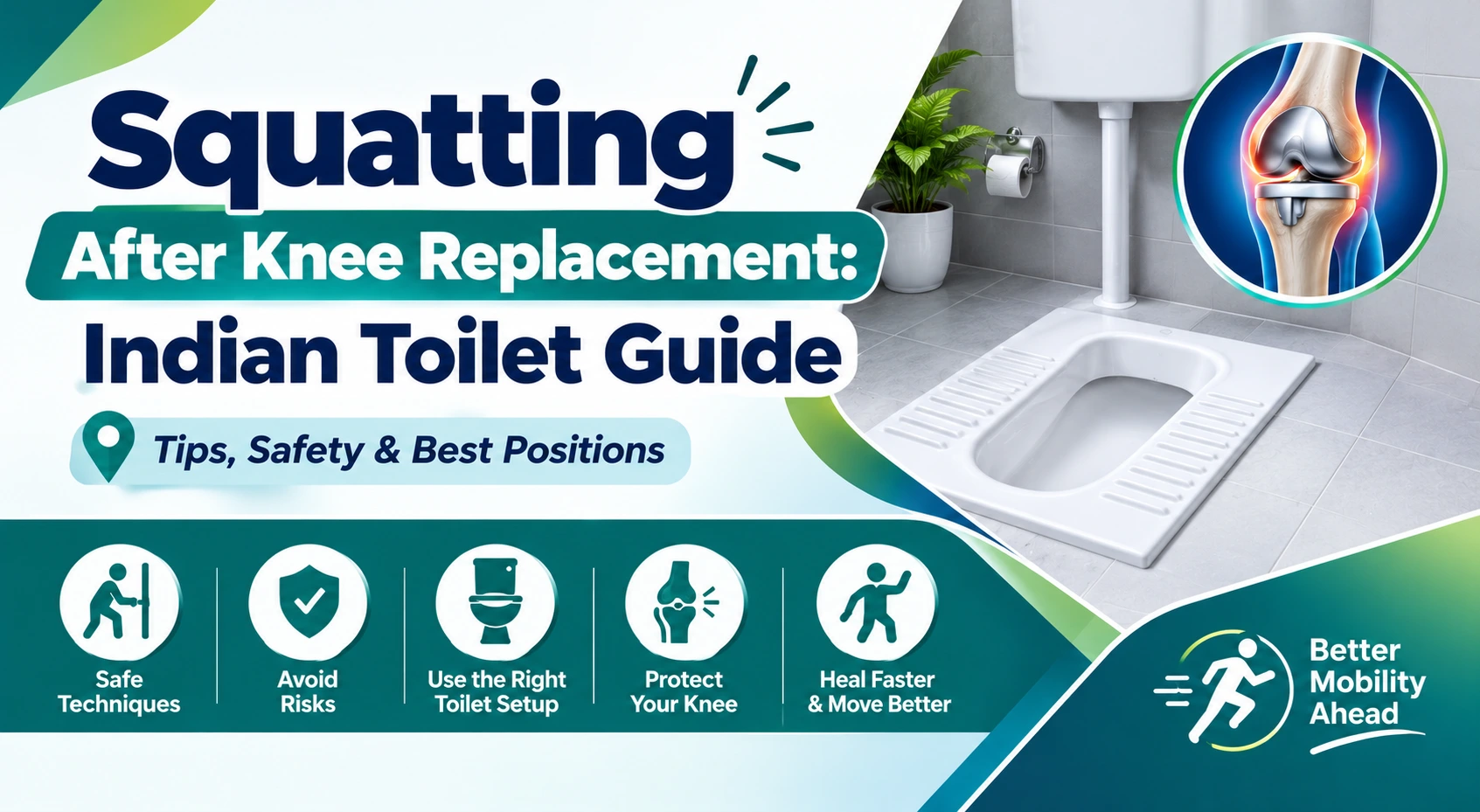
By Dr. Anuj Jain, M.B.B.S., M.S. (Orth), D.N.B., MNAMS Published and last updated: 15 October 2026.
Squatting after knee replacement is one of the most common questions Indian patients ask. Many of us eat, pray and use the toilet at floor level, so it is natural to worry about whether an Indian toilet will still be possible, or whether life will mean giving up sitting cross-legged for good. The honest answer depends on your knee and on your surgeon's advice. This article explains why these positions are a concern and what safer options exist during knee replacement recovery.
Why is squatting after knee replacement a concern?
A deep squat, like sitting cross-legged, needs the knee to bend further than most replaced knees comfortably go. Many people reach a bend of roughly 110 to 130 degrees after recovery, and a full squat asks for more than that. Deep bending can place higher stress on the implant and on the soft tissues around the joint, which is why surgeons often advise against deep squatting after knee replacement, especially in the first months.
Advice is not identical for everyone. It varies with the type of implant, the surgical technique and how well your knee moves, so your own surgeon's instructions should always come first. You can read general guidance on total knee replacement to understand what the operation involves.
Using an Indian toilet after knee replacement
An Indian toilet needs a deep squat that is held for some time, and standing up again demands strong thigh muscles. During early knee replacement recovery this is usually not advised. Safer arrangements include:
- A Western-style commode or a raised toilet seat, ideally arranged before you come home from hospital
- A commode chair or raised seat placed over the Indian toilet, if changing the fitting is not possible
- Grab bars or a firm support beside the toilet, and a dry, non-slip floor
- Someone nearby for the first few days at home, in case you feel unsteady
Please ask your surgeon when, if ever, a return to floor-level toilets is reasonable for you.
Sitting cross-legged, kneeling and prayer positions
Sitting cross-legged on the floor also needs a deep bend and some twisting at the knee, so it is generally discouraged after the operation. Kneeling on the operated knee can feel uncomfortable because the skin and scar area may stay sensitive for a long time. Both are worth discussing with your surgeon before you try them.
For daily routines that happen at floor level, these adjustments often help:
- Use a chair or a raised seat for meals and for puja or prayer
- Use a firm stool or a prayer chair instead of kneeling or sitting on the floor
- Keep a sturdy support nearby so that you can stand up without twisting the knee
How knee replacement recovery changes what is safe
Knee replacement recovery is gradual. In the early weeks the focus is on straightening and bending the knee, walking steadily and building thigh strength. Some exercises that look like squats are different from deep squatting after knee replacement: a supported mini-squat, where you hold a stable surface and bend only a little, is a strengthening exercise. These are covered in a guide to exercises after knee replacement. Everyday tasks such as climbing stairs after knee replacement follow their own safe technique.
A physiotherapist can tailor movements to your knee, and a structured plan of orthopaedic rehabilitation helps you progress at a pace that protects the joint.
Practical tips for daily life
- Prepare the home before surgery. Arrange a raised toilet seat or commode, a chair with arms and non-slip mats.
- Choose chairs over the floor. Use a chair for meals, puja and prayer instead of sitting cross-legged on the floor.
- Follow the physiotherapy plan. Knee replacement recovery goes better with regular, supervised exercise than with occasional long sessions.
- Do not force a deep bend. Pain, a sharp pull or swelling after a movement is a sign to stop and ask your surgeon.
- Keep your follow-up visits. Your surgeon can check how well the knee bends and update the advice on floor-level activities.
When to see your doctor
Please contact your surgeon if you notice:
- Increasing pain, swelling, redness or warmth around the knee
- Fever, or a wound that is leaking or opening
- The knee giving way, or a fall
- A bend that is not improving despite regular exercise
- Calf pain or swelling, which needs prompt medical attention
Chest pain or sudden breathlessness is an emergency: go to the nearest hospital immediately.
Key takeaways
- Deep squatting is usually discouraged once you have a replaced knee, though advice differs from person to person.
- If you use an Indian toilet at home, plan a raised seat or commode before surgery.
- Sitting cross-legged on the floor is also usually discouraged; a chair is a safer choice for meals and prayer.
- Knee replacement recovery is gradual, so follow your surgeon's and physiotherapist's advice rather than a general rule.
Disclaimer: This article is for general health education only. It is not a substitute for personal medical advice, diagnosis or treatment. Please consult a registered medical practitioner about your specific condition.

Useful Links
Our Services
Dr. Anuj Jain
 "Being an Orthopaedic Surgeons my aim is restoring mobility and keeping our nation in motion."
Dr. Anuj Jain
M.B.B.S., M.S. (Orth), D.N.B. Gold Medalist

